

01.
New fee schedule comes into effect.
The new BPTO fee schedule, approved by Ordinances GM/MDIC No. 110/2025 and BPTO/PR No. 10/2025, will take effect on August 7, 2025, and includes the following highlights for trademarks:
- New structure for registration fees: the fees for filing, granting, issuing the registration certificate, and the first ten years of the trademark's validity will be combined into a single payment at the beginning of the trademark registration application, as of September 20, 2025.
- The transition will take place as follows: owners of pending trademark registration applications, with approval published between June 24 and September 19, 2025, may decide to pay the fees for granting, issuing the registration certificate, and the first ten years of the trademark by September 19, obtaining the respective certificate immediately. Otherwise, applications that meet the above conditions will have their grant and certificate issuance processed only after September 22.
- Progressive adjustment: The fees for some services will be adjusted progressively. For most services, the new amounts will take effect on August 7. However, for some of the new services offered by the BPTO and for those that have undergone restructuring, the adjustments will take effect on September 20 and December 20.
For example, the fee for a trademark registration application by class (with free-form specification) will be R$ 420.00 between August 7 and September 19, 2025. As of September 20, the fee will increase to R$ 1,720.00, including the advance payment of the fees for granting and issuing the registration certificate and the first ten years of the trademark's validity. - Discounts of 50% or total exemption from fees: Individuals, MEIs, micro and small businesses, simple innovation companies, ICTs, non-profit entities, and national public agencies will be entitled to a 50% discount on some of the main BPTO fees. Low-income individuals and individuals with disabilities may be eligible for total exemption from certain services, provided they meet the legal criteria. In cases of joint ownership, all applicants must meet the conditions to enjoy the benefit.
- Encouraging the adoption of the Nice Classification: Applications filed through national channels that use product and service descriptions pre-approved under the Nice Classification may opt for reduced filing and registration fees.
Below is a table indicating the services that have been created and those that have undergone changes in their charging method:
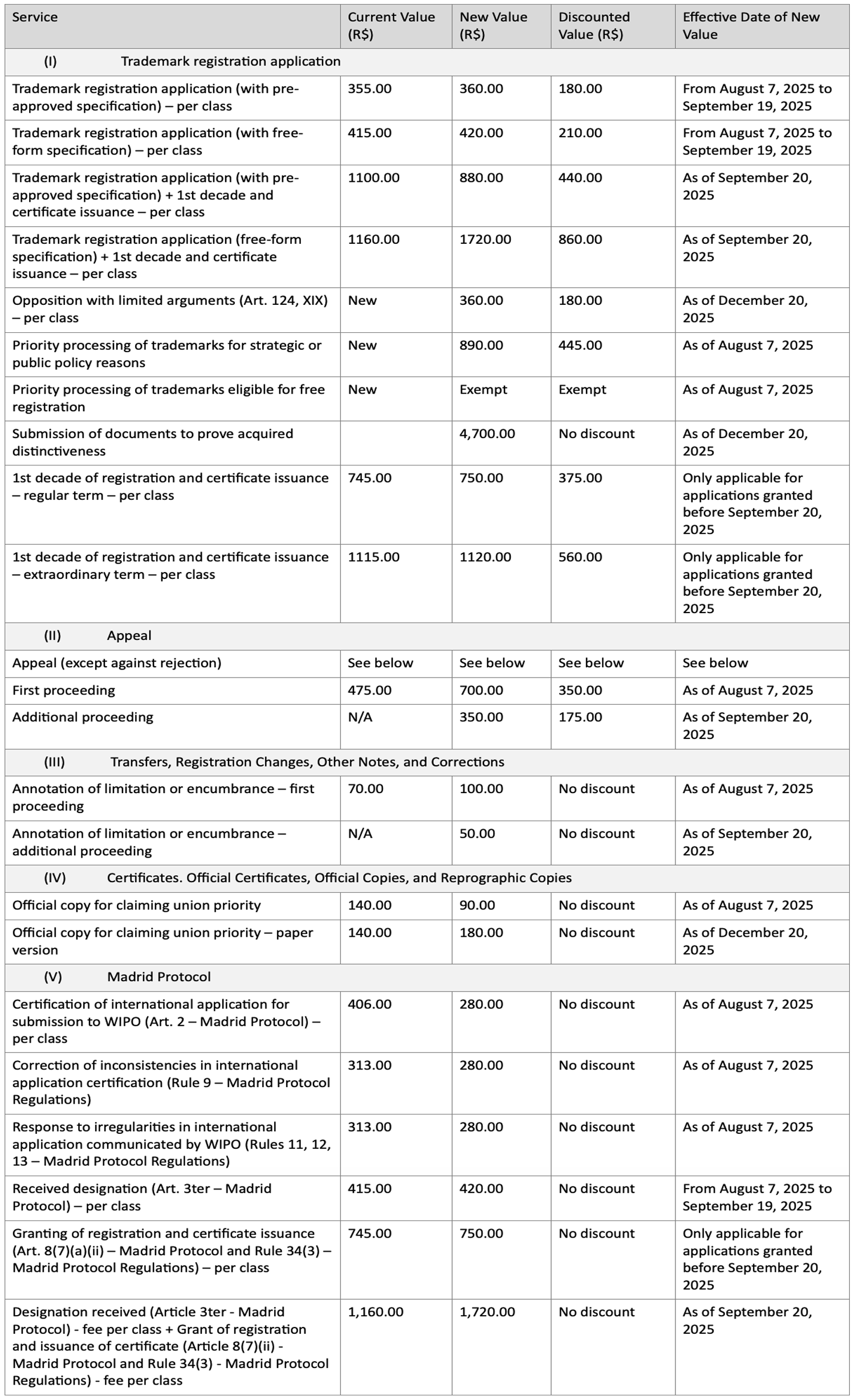
Ordinances GM/MDIC No. 110/2025 and BPTO/PR No. 10/2025, relating to changes in BPTO fees, as well as the complete table of trademarks, with all adjustments, changes, and effective dates, can be accessed here:
- GM_MDIC ORDINANCE No. 110 OF 2025 - Table of Fees for Services Provided by the BPTO in force on Aug 7 2025
- BPTO_PR ORDINANCE No. 10 OF 2025 - New complete table with application of discounts
- Official BPTO fee schedule for all fees - Ordinance MDIC No. 110_2025 and 10_2025
- BPTO fee schedule edited by Dannemann Siemsen for trademark services
02.
Registration based on acquired distinctiveness: new possibilities for protection.
With the publication of ordinance No. 15/2025, the BPTO regulates the registration of trademarks based on acquired distinctiveness. This approach recognizes that signs or expressions that are initially generic or descriptive may, through effective and consistent use in the market, acquire sufficient distinctiveness to be recognized as exclusive trademarks to identify products or services, differentiating them from the competition.
To this end, the owner must prove:
- Substantially continuous use of the sign in the three years prior to the application;
- Recognition by a significant portion of the relevant public that the sign exclusively identifies their products or services.
Recognition of acquired distinctiveness may only be requested from the BPTO once and at the following stages of the administrative process:
- On the date of filing of the trademark registration application;
- Within 60 days from the date of publication of the registration application;
- On the date of filing of an administrative appeal against a decision to reject a trademark registration application based on the absence of inherent distinctiveness;
- On the date of filing of the opposition based on lack of distinctiveness;
- On the date of filing of the statement in the administrative nullity proceeding based on lack of distinctiveness.
The ordinance grants an extraordinary period of 12 months, starting from its effective date, for owners with applications pending or with trademarks under invalidity request based on lack of distinctiveness to file a request for recognition of acquired distinctiveness, duly proven by documentation of use.
This new service will begin upon the entry into force of the ordinance on November 28, 2025.
This is a strategic opportunity for brands that have built a reputation around signs that were initially unregistrable.
BPTO Ordinance No. 15/2025 can be accessed here.
03.
Priority processing of trademarks.
The priority processing project aims to expedite the analysis of trademark applications and petitions, applying to both national registration applications and applications for registration via the Madrid system.
- Objective and deadline: The goal is to examine prioritized cases or petitions within two months for cases with regular flow and no requirements.
- How to apply: The request is made via a specific electronic form.
- Types of priorities:
- Priorities defined by law. Includes individuals (elderly, seriously ill, disabled), sole proprietorships, and Inova Simples companies.
- Priorities based on strategic objectives and public policies. The applicant must fall into one of the following modalities:
- Opponents who invoke the right of precedence to registration in opposition proceedings, based on §1 of Article 129 of the Industrial Property Law (IPL);
- Those who depend on the granting of trademark registration for the release of public financial resources;
- A party involved in legal proceedings, except for writs of mandamus, at the federal or state level, involving the trademark;
- Those who have a product or service resulting from a patent prioritized by the BPTO;
- Legal entities considered Scientific, Technological, and Innovation Institutions (ICT), as defined by law;
- Individually mentored by the BPTO under a Technical Cooperation Agreement in force; and
- Those covered by situations of public interest or national emergency declared by the Federal Executive Branch.
- Limits and Implementation:
- The initial phase of the priority trademark process (phase 1 of the pilot project), which covers the modalities established based on strategic objectives and public policies and which runs from August 7 to December 7, 2025, will make available a single quota of 1,200 (one thousand two hundred) applications, with a minimum quota of 100 applications per modality guaranteed, the remaining quotas being freely available to applicants of any modality, with a maximum of three protocols per applicant. The regulations were published on July 29, and the project will be implemented starting on August 7, 2025, coinciding with the BPTO's new fee schedule. The systems will be unavailable on August 7 and 8 for updating.
- The modalities and quotas were published in separate ordinances to allow for greater flexibility in future revisions and adjustments.
- Official fee:
- For priorities based on strategic objectives and public policies: fee of R$ 890.
- For priorities defined by law: no fee.
This new service will begin when the ordinance comes into force on August 7, 2025.
Our firm is prepared to advise clients on eligibility analysis, document preparation, and monitoring of the process with the BPTO.
The ordinances regulating the priority processing of trademarks, as well as phase 1 of the pilot project, can be accessed here.
04.
Trademark Opposition 2.0 (simplified opposition).
This measure aims to simplify the examination of certain oppositions, considering the growing volume of petitions.
- Objective: To allow the filing of oppositions based exclusively on item XIX of article 124 of the Industrial Property Law, i.e., against trademark registration applications that reproduce or imitate a third party's trademark already registered to distinguish or certify an identical, similar, or related product or service, when there is a possibility of causing confusion or undue association with the preexisting trademark.
- Functionality: The user will provide the numbers of the applications or registrations to be protected directly on the BPTO form, without presenting any reasons or other grounds. The system will validate the information.
- Benefit: The first examination will be carried out within the same timeframe as registration applications without opposition (the target is 21 months for this year), speeding up the analysis of oppositions that fall under this criterion.
- Limitations: Opposition 2.0 is limited to the indication of five previous registrations per opposed class (multiplying for multi-class applications). For broader claims or claims based on other sections of Article 124 of the IPL, the conventional opposition service must be used.
- Relevance: Internal BPTO data show that more than 88% of registration applications rejected on the basis of oppositions in the last 12 months had their decision based solely on Article 124(XIX).
- Prejudice to speed: If a conventional opposition is filed against the same application that has also been subject to an opposition 2.0, the examination period that will prevail will be that of the conventional opposition.
- Schedule: The special form has already been developed and tested. The connection with the support portals has been confirmed. The service is scheduled to come into effect on December 20, 2025.
05.
Recognition of the High Renown of Trademarks.
The BPTO published the ordinance PORTARIA/BPTO/PR No. 25 of 2025, which provides parameters for proving the high renown of a trademark in Brazil, amending BPTO ordinance No. 08 of January 17, 2022, with regard to this matter and modifying the guidelines on this subject in the BPTO Trademark Manual.
The new rules stipulated by the BPTO aim to establish clear and uniform parameters for research to prove the high renown, making the process more transparent and predictable.
- Context: Based on 2014 criteria, the new rules seek to formalize the parameters for market and image research, which are the most recommended types of evidence.
- Main points (from the Trademark Manual):
- Minimum sample: 2,000 respondents to ensure representativeness of the Brazilian population.
- Confidence level: Inclusion of a reference to a 95% confidence level.
- Online surveys: no restrictions on online surveys.
- Sample representativeness: focus on economic classes (ADEP methodology) and age/education groups.
- How the research is conducted: Trademarks registered in black and white may be shown in their colors known to the public.
- Prior consultation: Possibility of consulting the BPTO commission via "Contact Us" about descriptive elements of the trademark that may lead to obvious recognition, as well as about the structure of the research itself, avoiding the need to redo costly research.
- "Screening" questions: Recommended (not mandatory) for online research in order to avoid leading responses.
- Recognition percentages in market research analysis:
- Greater than 71% (discounting the margin of error): Market research alone is sufficient to prove the high renown, with no further evidence required.
- Between 61% and 71% (excluding the margin of error): Additional supporting evidence will be required, as illustrated in the manual.
- This percentage refers to the total sample that knows the brand and correctly associates it with the product or service for which it is intended.
- Future improvements: The BPTO will continue to study the possibility of allowing the indication of more than one registration (or class in multi-classes) to prove the high renown, as well as defining percentages for other recognition criteria.
- Cooperation: The BPTO seeks to create channels for dialogue and communication, ensuring that a requirement will always be formulated before a final rejection (except for exempt petitions).
- Confidential data: There are currently no resources to keep confidential documents in trademark proceedings. Dialogue with the commission is recommended for guidance on how to submit data without revealing industrial/commercial secrets.
The changes do not apply retroactively and will take effect on August 7, 2025. Companies interested in applying for recognition of high renown should pay attention to the new requirements and the need for consistent evidentiary planning.
BPTO Ordinance no 25 of 2025 and the new rules of the BPTO Trademark Manual for proving high reputation of a trademark can be accessed here:
06.
Artificial intelligence (AI) initiatives in trademarks:
The BPTO is undertaking several initiatives to integrate AI into its processes, aiming at greater efficiency and transparency.
- Two major objectives:
- Develop a search tool for examiners to assist in the examination process.
- Provide external users with a simplified filing system to assist in the classification and identification of prior trademarks.
- Schedule (planned deliverables):
- September 2025: delivery of the search module for examiners;
- February 2026: external module with name search for users;
- August 2026: figurative search module;
- December 2026: module for identifying other absolute impediments, culminating in the preliminary search interface and smart filing form for external users.
- Expected results: greater predictability and uniformity in search tools, increased quality of decisions, legal certainty, reduced examination time, and transfer of technology and infrastructure to the BPTO.
- Important: AI will function as an aid, not seeking to completely automate the examination.
You can count on our firm.
The trademark landscape in Brazil is undergoing significant changes that require attention, planning, and legal strategy.
Our team is available to guide your business through the new rules, assessing risks, opportunities, and alternatives appropriate to each case.